
Monday, March 3, 2014
Spring Festival Gala
http://english.cntv.cn/special/2014springfestival/gala/index.shtml
The only time we could watch TV in China was in our hotel room when we traveled. The Tube in our apartment…dead. Fine. Too much else to do than watch it anyway. But while we were traveling in Viet Nam during the high holy days of Spring Festival, every Chinese TV channel was carrying the same super variety show; of which I knew nothing until one of my students gave an information presentation. Folks, this is the biggest…I mean BIGGEST TV production on planet Earth with the largest viewing audience on the planet, as well. CCTV goes to the mat for this baby. I included a link to a review of the 2014 Gala, but you can find any number of links to see the glitz 'n glamor. The Oscar's got nothing on these folks.
Here is my student's presentation:
The first CCTV New Year's Gala was held in 1982, with performers in the arts, drama, dance, and song from all over the country. Research commissioned by China Television Research (CTR) in 2007 indicated that an estimated 93.3% of Chinese families watched the Gala on television.
It is an evening gala of the drama, dance, and song, which is broadcast on the eve of Chinese New Year; live on CCTV-1 by satellite on CCTV-4, CCTV-E and CCTV-F and more recently on CCTV-HD. Because it is viewed by an estimated 700 million people on New Year's Eve every year, the Spring Festival Gala has become a cultural phenomenon beginning in the early 1980s in mainland China, and since then has become a necessity of New Year's nights.
Harmony and reunion are the two themes of the Gala. With a cheerful atmosphere, laughter and applause permeate from start to finish. The Gala usually starts at 8 p.m. on New Year's Eve and lasts about four hours. The program's TV ratings have ranked first among China's variety show programs over the past two decades.
Its importance has reached over to political, economic, and ethnic areas. As the Eve of Chinese New Year is a time where the family gathers, the typical situation involves a large 3-generation family gathered in front of their TV set while making dumplings for the first New Year's meal. The Gala adds a mood of celebration in the house as people laugh, discuss and enjoy the performance. It has become an ingrained tradition on Mainland CHina to watch the New Year's Gala on New Year's Eve. But it is difficult to cater to all audience's tastes. Each year the gala hope to incorporate new ideas and surprise people. Both director and performers rack their brains during writing and rehearsals. It has become a big challenge for CCTV and its creative staff.

Saturday, February 15, 2014
Holiday Paper Decor
Christmas decorations are ubiquitous in Jinan, China; not restricted to the traditional western holiday season. 'Twas interesting to see fully decorated Xmas trees year-round in restaurants and hotel lobbies. Colorful paper Santa's often decorated walls and windows all year. Red paper and silk lanterns are ever-present though out China. Speaking of paper…intricate, beautiful red paper cuttings are hung on walls and windows all over during China during the high holiday Spring Festival/Chinese New Year season. And unlike Xmas lights in the West, they don't necessarily come down right after the festival season are over.


One of my students gave an interesting report on Chinese Paper Cutting. The intricacy of these creations is absolutely amazing. And the designs are just random creations; there is lots of meaning and tradition in the images. I'll let Silver tell you more about it:
Chinese paper cutting or Jianzhi is the first type of paper cutting design, since paper was invented by Cai Lun in the Easter Han Dynasty in China. It has a history of more than 1500 years and it represent cultural values of the people throughout China.
The oldest surviving paper cut out is a symmetrical circle from the 6th century found in Xinjiang, China. The art spread to the rest of the world in the 14th century. Throughout the Qing Dynasty many paper cutting skills were developed including drafting and the use of smoked papers. By the end of the Qing rule however, new art forms were being introduced. The Republic of China later tried to revive the art in the 1980's.
In the rural countryside in mainland China, paper cutting is a traditionally female activity. In the past, every girl was expected to master it and brides were often judged by their skill.

There are basic cut outs that are a single image And there are symmetrical designs that are usually created by some folding over a proportioned crease, and then cutting some shape. WHen unfolded, it forms a symmetrical design. Chinese paper cuttings are normally symmetrical.
Because the cut outs are also used to decorate does and windows, they are sometimes referred to as "chuang hua" meaning Window Flower. Today, paper cuttings are chiefly decorative. They ornament walls, windows, doors, columns, mirrors, lamps and lanterns in homes and are also used on presents or are given as gifts themselves. Entrances decorated with paper cutouts are supposed to bring good luck. Paper cuttings used to be used as patterns, especially for embroidery and lacquer work.

In Chinese culture it can reflect many aspects of life such as property, health or harvest. Some cuttings represent stories about the happiness gained from the accomplishment of common goals.
There are two methods of manufacture: one uses scissors, the other uses knives.
There is a saying in China that means something left over year after year. The last Chinese symbol of this phrase is homophonic with the word fish in Chinese. When Spring Festival comes, most families buy Chinese paper cutting in the shape of fish and paste it on the door.
In conclusion, Chinese paper cutting implies the great charm of Chinese culture and it is also a precious possession that should remain forever.

One of my students gave an interesting report on Chinese Paper Cutting. The intricacy of these creations is absolutely amazing. And the designs are just random creations; there is lots of meaning and tradition in the images. I'll let Silver tell you more about it:
Chinese paper cutting or Jianzhi is the first type of paper cutting design, since paper was invented by Cai Lun in the Easter Han Dynasty in China. It has a history of more than 1500 years and it represent cultural values of the people throughout China.
The oldest surviving paper cut out is a symmetrical circle from the 6th century found in Xinjiang, China. The art spread to the rest of the world in the 14th century. Throughout the Qing Dynasty many paper cutting skills were developed including drafting and the use of smoked papers. By the end of the Qing rule however, new art forms were being introduced. The Republic of China later tried to revive the art in the 1980's.
In the rural countryside in mainland China, paper cutting is a traditionally female activity. In the past, every girl was expected to master it and brides were often judged by their skill.
There are basic cut outs that are a single image And there are symmetrical designs that are usually created by some folding over a proportioned crease, and then cutting some shape. WHen unfolded, it forms a symmetrical design. Chinese paper cuttings are normally symmetrical.
Because the cut outs are also used to decorate does and windows, they are sometimes referred to as "chuang hua" meaning Window Flower. Today, paper cuttings are chiefly decorative. They ornament walls, windows, doors, columns, mirrors, lamps and lanterns in homes and are also used on presents or are given as gifts themselves. Entrances decorated with paper cutouts are supposed to bring good luck. Paper cuttings used to be used as patterns, especially for embroidery and lacquer work.
In Chinese culture it can reflect many aspects of life such as property, health or harvest. Some cuttings represent stories about the happiness gained from the accomplishment of common goals.
There are two methods of manufacture: one uses scissors, the other uses knives.
There is a saying in China that means something left over year after year. The last Chinese symbol of this phrase is homophonic with the word fish in Chinese. When Spring Festival comes, most families buy Chinese paper cutting in the shape of fish and paste it on the door.
In conclusion, Chinese paper cutting implies the great charm of Chinese culture and it is also a precious possession that should remain forever.
Wednesday, January 29, 2014
Should China Allow Her People to Have a Second Child?
Recently, a new regulation was added to China's famous One-Child Policy. If the husband is an only child but the wife is not, that couple will be allowed to have two children; or visa versa. Previously, the new policy was that both husband and wife had to be only children to be allowed to give birth to a second child in China.
One of my students gave an insightful presentation on this topic under the above title. Here is what she said:
In the early 1970s, China started to carry out the one-child policy. At that time, the population in China was so large that it brought many problems to our society. We could not provide enough food and education for all the people, so the government needed to control its population. Everyone had to accept that we don't allow one couple to have a second child. The policy on family planning is reasonable and necessary. Though it is a big challenge for the traditional opinion of "More children, more happiness."
In most of cities, a couple only can have one child, and in most of villages, only two children. You will be punished seriously if you have one more illegal children, like having to pay large amount of money maybe 20,000 or 30,000 yuan. I know that because one of my neighbor paid 30,000 yuan to get a boy as the second child. Or, most cruelly, maybe you are forced to have an abortion. There are many bloody example that I cannot list because saying that is illegal.
In this way, the growth rate of population declined sharply, from 5.8 percent growth in 1970 to 2.24 percent in 1980, reducing the great stress on economic development. However, some people still fight against this policy, which are from both personal and public point of view.
One-child policy is harmful to the development of the kid's character and personality. The first generation won't have siblings, and the send generation won't have siblings or first cousins. Many children will be spoiled, resulting in the "little emperors." Many parents spoil their children because they give them everything they want, and almost never ask them to do anything at home. All these make them show of basic skills in life and unpopular with the society in the future.
Furthermore, the lack of brothers or sisters in the family does great harm to their psychological development as they may feel lonely all the time. "I do not want to be the only child of my family," one of my best friends had told me. "I always feel lonely and helpless." I have discussed it with my classmates who are the only child and they have got the same feeling. When school is over, we go back home and have no one to talk with, for parents are busy with their jobs or house chores. Even when they have leisure time, due to the generation gap, we have nothing in common. On our way to adulthood, we have met a lot of trouble on which they linger and ponder.
The effect of the policy on the sex rate has received much attention. Women have always been considered the lower sex in China, despite the Chinese Government trying to change it. Because we are deeply influenced by conservative, traditional Chinese thinking pattern, the couples who have a baby girl sometimes they will kill or abandon their child, so they can try again for a boy. Because of the large number of infanticide and abandoned girls, China now has an unbalanced population; with a lot more boys than girls. This results in a high umber of girls going into prostitution.
When the first generation of law-enforced only children become parents themselves, one adult child was left with having to provide support for his or her two parents and four grandparents. In China, this problem has been named the
"4:2:1: phenomenon, meaning that increasing numbers of couples will be solely responsible for the care of one and four parents. If the old people are in different places, how can the couple take care well of all these old people?
To conclude, the policy was reasonable in the late 70s. But the time has changed, I think, and the one-child policy should change very soon. Only in this way can we solve these problems and make China become a real harmonious country.
The operative word is IN China regarding one child. Many educated couples leave China to work abroad and have one or two children which they can legally bring back to China. Then they can have their 1 child in China and all is well; so long as they can afford them. And that is the biggest factor today. Regardless of policy easing, it is just too expensive to have more than one child anymore; and in some cases not worth the trouble to have any children.
A popular actor ran afoul of the law when it was discovered that he had a lot a children who are now adults. Outing celebs and officials in China is the latest game in social media….like anywhere else in the world.
One of my students gave an insightful presentation on this topic under the above title. Here is what she said:
In the early 1970s, China started to carry out the one-child policy. At that time, the population in China was so large that it brought many problems to our society. We could not provide enough food and education for all the people, so the government needed to control its population. Everyone had to accept that we don't allow one couple to have a second child. The policy on family planning is reasonable and necessary. Though it is a big challenge for the traditional opinion of "More children, more happiness."
In most of cities, a couple only can have one child, and in most of villages, only two children. You will be punished seriously if you have one more illegal children, like having to pay large amount of money maybe 20,000 or 30,000 yuan. I know that because one of my neighbor paid 30,000 yuan to get a boy as the second child. Or, most cruelly, maybe you are forced to have an abortion. There are many bloody example that I cannot list because saying that is illegal.
In this way, the growth rate of population declined sharply, from 5.8 percent growth in 1970 to 2.24 percent in 1980, reducing the great stress on economic development. However, some people still fight against this policy, which are from both personal and public point of view.
One-child policy is harmful to the development of the kid's character and personality. The first generation won't have siblings, and the send generation won't have siblings or first cousins. Many children will be spoiled, resulting in the "little emperors." Many parents spoil their children because they give them everything they want, and almost never ask them to do anything at home. All these make them show of basic skills in life and unpopular with the society in the future.
Furthermore, the lack of brothers or sisters in the family does great harm to their psychological development as they may feel lonely all the time. "I do not want to be the only child of my family," one of my best friends had told me. "I always feel lonely and helpless." I have discussed it with my classmates who are the only child and they have got the same feeling. When school is over, we go back home and have no one to talk with, for parents are busy with their jobs or house chores. Even when they have leisure time, due to the generation gap, we have nothing in common. On our way to adulthood, we have met a lot of trouble on which they linger and ponder.
The effect of the policy on the sex rate has received much attention. Women have always been considered the lower sex in China, despite the Chinese Government trying to change it. Because we are deeply influenced by conservative, traditional Chinese thinking pattern, the couples who have a baby girl sometimes they will kill or abandon their child, so they can try again for a boy. Because of the large number of infanticide and abandoned girls, China now has an unbalanced population; with a lot more boys than girls. This results in a high umber of girls going into prostitution.
When the first generation of law-enforced only children become parents themselves, one adult child was left with having to provide support for his or her two parents and four grandparents. In China, this problem has been named the
"4:2:1: phenomenon, meaning that increasing numbers of couples will be solely responsible for the care of one and four parents. If the old people are in different places, how can the couple take care well of all these old people?
To conclude, the policy was reasonable in the late 70s. But the time has changed, I think, and the one-child policy should change very soon. Only in this way can we solve these problems and make China become a real harmonious country.
The operative word is IN China regarding one child. Many educated couples leave China to work abroad and have one or two children which they can legally bring back to China. Then they can have their 1 child in China and all is well; so long as they can afford them. And that is the biggest factor today. Regardless of policy easing, it is just too expensive to have more than one child anymore; and in some cases not worth the trouble to have any children.
A popular actor ran afoul of the law when it was discovered that he had a lot a children who are now adults. Outing celebs and officials in China is the latest game in social media….like anywhere else in the world.
Friday, January 17, 2014
This Might Be The Scariest Trail In The World.
The camera shots of this trail have traveled around the world several dozen time by now. But living in China brings a whole new perspective to this perilous adventure.
There are 5 recognized "sacred" mountains in China. I'm not sure if this is one of them. Nevertheless, it's probably on a few million Chinese bucket lists.
Xi'an, which is the major city near this mountain, is the oldest capital of China (about 4000 yrs old); home of the famous Terra Cotta Warriors from the tomb of the first major, uniting and fierce Emperor Chin. It wouldn't surprise me if the monks who carved out this treacherous path weren't motivated by a desire to flee from the emperor's famous wrath…and need for tons of cheap labor; what with building a massive tomb & Great Wall, and all.
In the 8th, 10th, 11th & 12th photos I saw something I would have escaped my understanding before living in China.
We hope you’re not afraid of heights, because this even made our palms sweat. What you see below is a mountain in China called Mt. Hua Shan. At its base, you’ll find a gigantic set of stone stairs, called “the Heavenly Stairs.” These stairs go so high up the mountainside, it’s hard to see where they end. If that wasn’t enough, the precarious stairs lead to the world’s most dangerous trail, the Hua Shan plank path. The plank trail leads high up the Hua Shan mountain just outside the city Xi’an. No one will force you to wear safety gear, although it’s strongly encouraged. The trail itself is dangerous and stunning, but what is at the top will really shock you.


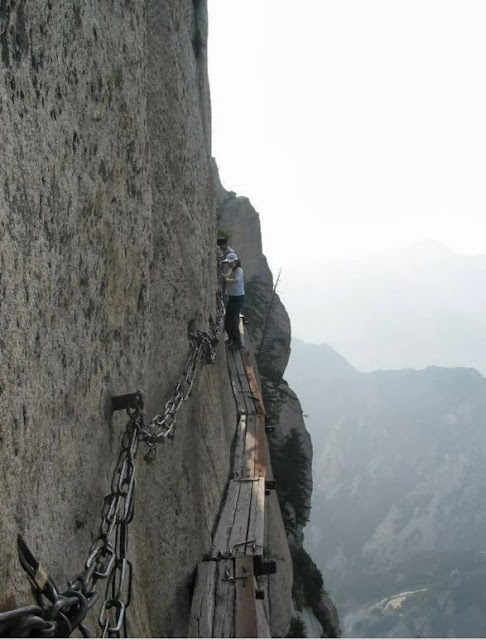


There are 5 recognized "sacred" mountains in China. I'm not sure if this is one of them. Nevertheless, it's probably on a few million Chinese bucket lists.
Xi'an, which is the major city near this mountain, is the oldest capital of China (about 4000 yrs old); home of the famous Terra Cotta Warriors from the tomb of the first major, uniting and fierce Emperor Chin. It wouldn't surprise me if the monks who carved out this treacherous path weren't motivated by a desire to flee from the emperor's famous wrath…and need for tons of cheap labor; what with building a massive tomb & Great Wall, and all.
In the 8th, 10th, 11th & 12th photos I saw something I would have escaped my understanding before living in China.
We hope you’re not afraid of heights, because this even made our palms sweat. What you see below is a mountain in China called Mt. Hua Shan. At its base, you’ll find a gigantic set of stone stairs, called “the Heavenly Stairs.” These stairs go so high up the mountainside, it’s hard to see where they end. If that wasn’t enough, the precarious stairs lead to the world’s most dangerous trail, the Hua Shan plank path. The plank trail leads high up the Hua Shan mountain just outside the city Xi’an. No one will force you to wear safety gear, although it’s strongly encouraged. The trail itself is dangerous and stunning, but what is at the top will really shock you.


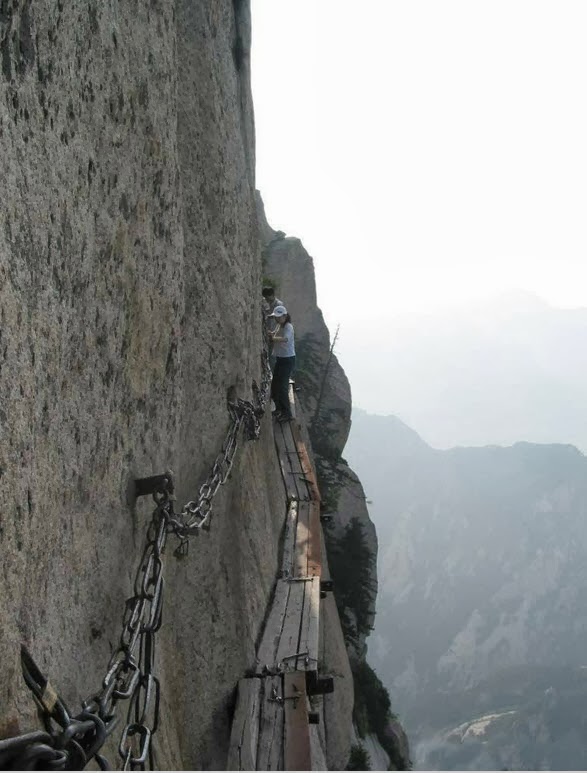

In this section of photos you may notice LOCKS attached to the chains. We saw thousands of these locks in China and Korea; usually in high places like giant towers and mountain tops. In every case they are attached and locked in place by young couples who are witnessing their love for each other & sealing their love in sacred, formidable places.


This series of photos reminded us of the many repair jobs in China. No concept of safety codes in this country. I don't think I could handle viewing a photo of the workers building this plank trail !!


So, either these people really like dangerous climbing, or they really like tea. Either way, you should probably check out the teahouse at the top of Mt. Hua Shan.
Just make sure to bring a helmet. ….WHY? A helmet will save your fall?
Sunday, January 12, 2014
BYU Dance Group Bridges Cultures, Builds Connections in China
Sharing a passion for the arts brought dancers from Brigham Young University and China together in a unique cross-cultural experience.
BYU’s Contemporary Dance Theatre recently returned from a trip to China where they performed as invited guests in a prestigious dance festival showcasing China's top university dancers. BYU was the only group from outside China to perform.

The visit to China is the latest in a series of outreach efforts by performing arts groups and others at the BYU College of Fine Arts and Communications, designed to build relationships and connections around the world. The invitation marked the 28th time since 1979 that performing troupes from BYU have visited China.

“Despite our differences in language and geography, the value of the arts, including those human expressions of love, goodness, truth, beauty, and excellence unite us,” said Stephen Jones, dean of BYU's College of Fine Arts and Communications.

BYU dancers presented Encounters, a show that explores the meshing of both different styles and different cultures. They performed three times, including at the Chun Hua Qiu Shi festival in the National Centre for the Performing Arts in Beijing.

The experience also served as an opportunity to collaborate with members of the Beijing Dance Academy, many of whom visited BYU last year to perform with students from the BYU Department of Dance.
“These excellent institutions are committed to the success of their students,” said Wang Wei, vice president of the Beijing Dance Academy. “We hope all of these student participants will use their gifts to express to the world their conviction that beauty and goodness will always overcome the challenges and difficulties of life, and that through our work together we can preserve the best fruits of our cultures and societies for future generations.”
Students from BYU and the Beijing Dance Academy had only three days to prepare for what would be the final dance of the program. Although only a handful of the dancers from either group spoke the others’ language, they were able to merge together to deliver a spectacular performance. Jiamin Huang, a former student of Beijing Dance Academy and now a BYU associate professor of Dance, choreographed the final number.
Nathan Balser, assistant professor of dance at BYU and artistic director for Encounters said the variety of dance styles performed by the Contemporary Dance Theatre ensemble presented a unique challenge.
“We were asked to represent ballroom, folk, and other entities,” Balser said. “In response we created and performed this concert wherein our dancers showcased all of these genres.”

Balser was quick to point out the talent he saw on display from his dancers, but he was just as impressed with their work ethic. Before the trip, the group rehearsed continually, putting in a lot of extra hours. In the end, they saw it pay off and the dancers from both sides shared some special moments.
“I found all of the dancers circled up behind the curtain, expressing their love and gratitude to each other,” Balser said. “While I didn’t get to join in the conversation, I could sense that it was a really special moment for all of them.”
Tuesday, January 7, 2014
Precious & Scarce
We take some of things for granted in the West…like tissue paper at critical moments or napkins in public eateries. Because my squat stats are 0 in China I never experienced one of those tissueless critical moments but I was always prepared to supply my Beloved with his needs because there are no tissue dispensers in public WC's in China, at least not in the dozen cities we have visited.
Our students taught us to carry with us at all times the ubiquitous, tiny packet of tissues. Students never needed to ask to leave class as the reason was obvious when they hurried out carrying the precious tiny packet. It was sweet to see a student's kind generosity as a packet was quickly handed to a friend as he/she rushed out of class.
For some reason, paper and public don't mix in China.
What passes for napkins in even the finest restaurants can be best described as tissue paper…small tissue paper. Only one tissue-napkin per customer was handed to us as we paid our bill at our favorite Chinese buffet restaurant. Sometimes a nice restuarant will give you a small box of tissues perfect for blowing one's nose but scarcely adequate for protecting one's lap or wiping ones hand's. Come to think of it, maybe that's not what the box of tissues is for?
One of the reasons for my 0 public WC stats is that precious tissues are stashed in open baskets rather than flushed in China. Not going there.
Even after giving this paper dilemma a thought or two, I can't figure if this scarcity is due to the lack of this resource in China or the general lack of regard for people's needs.
Our students taught us to carry with us at all times the ubiquitous, tiny packet of tissues. Students never needed to ask to leave class as the reason was obvious when they hurried out carrying the precious tiny packet. It was sweet to see a student's kind generosity as a packet was quickly handed to a friend as he/she rushed out of class.
For some reason, paper and public don't mix in China.
What passes for napkins in even the finest restaurants can be best described as tissue paper…small tissue paper. Only one tissue-napkin per customer was handed to us as we paid our bill at our favorite Chinese buffet restaurant. Sometimes a nice restuarant will give you a small box of tissues perfect for blowing one's nose but scarcely adequate for protecting one's lap or wiping ones hand's. Come to think of it, maybe that's not what the box of tissues is for?
One of the reasons for my 0 public WC stats is that precious tissues are stashed in open baskets rather than flushed in China. Not going there.
Even after giving this paper dilemma a thought or two, I can't figure if this scarcity is due to the lack of this resource in China or the general lack of regard for people's needs.
Thursday, January 2, 2014
Who Is The Incredible Lily?
It is a ubiquitous custom in China that when an elderly person comes on the bus a younger person will stand up and give the elderly person his/her seat. On Sunday morning, March 3rd, white-haired, elderly-looking John got on Bus 16 for a 40 minute bus ride to attend church at the Hanlin Hotel; but, oddly enough, no one offered him a seat. Then a young lady who was standing told another young person who was seated to stand up and give John the seat. The person complied and when John gratefully took the seat he started up a conversation with the young lady who we now know is the incredible Lily. He introduced us as English teachers at Shandong University and offered to help her improve her English if she was willing to do so; which she was. That was the beginning of a great friendship.
She enjoyed the opportunity to practice her English with us and we enjoyed giving her "first" opportunities. Plus, Lily gave us incredible assistance with all manner of things during our second semester that we didn't have first semester, which really made our China experience more positive and memorable. Lily is an expert at bargaining in the night markets because she earned her way through college selling merchandise on the street/night markets.
We took Lily to Jennie's Cafe where she attempted to eat with a knife, fork & spoon for the first time. It wasn't easy for her…kind of like us manipulating chopsticks for the first time. We took Lily with us when we dined out at a Chinese restaurant and she helped us order delicious and interesting Chinese dishes that we would not have known to get without her.
Lily was with us once while we were tutoring three young elementary students in oral English, and she told us that she did not start school in her village until she was nine years old. While she couldn't attend one of the better high schools, she still applied herself to her studies and learned English quite well in record time.
The year before we met Lily, she graduated from a three-year technical university which was a few miles away from Shandong University and now she has a good job in Jinan. She rents an apartment located about a 20-minute bus ride from our apartment, with five other working gals. Her apartment is very old; older than the apartments that were built to accommodate China's Soviet-style heating system in which radiator-heat is turned on November 1st and turned off April 1st. So, there is no heat in her apartment during the winter. Neither was there any heat in her village home where she grew up. As of today, the only time Lily experienced heat during the winter was during the 3 years she lived in a dormitory while she attended the technical university.
To visit her family, Lily travels for five hours on an old, slow train for which she pays a standing-room-only ticket; and then takes a one-hour bus ride to her village. So it was with great delight that she took her first high-speed train ride with us. We took her with us on our trips to Qingdao, Mt. Tai, the Kong estate (Confucius), and Nanjing; which was the first time she experienced good American-style hotels and restaurants. And she enjoyed her first Chinese feast in a fancy Chinese restaurant with us. It was a lot of fun giving Lily interesting "first" experiences. Perhaps the best 'first' was when we rode the motorized boats at Daming Lake and let her drive the boat around the lake for an hour. This inspired her to study and take lessons to get her first driver's license. She went on her first tour with American tourists on the northern Silk Road which really helped her practice her English. All the Americans loved her like we do and she was such a helpful bargainer.
Our first trip to China was magnified because of the 'first' experiences we shared with the incredible Lily.
She enjoyed the opportunity to practice her English with us and we enjoyed giving her "first" opportunities. Plus, Lily gave us incredible assistance with all manner of things during our second semester that we didn't have first semester, which really made our China experience more positive and memorable. Lily is an expert at bargaining in the night markets because she earned her way through college selling merchandise on the street/night markets.
We took Lily to Jennie's Cafe where she attempted to eat with a knife, fork & spoon for the first time. It wasn't easy for her…kind of like us manipulating chopsticks for the first time. We took Lily with us when we dined out at a Chinese restaurant and she helped us order delicious and interesting Chinese dishes that we would not have known to get without her.
Lily was with us once while we were tutoring three young elementary students in oral English, and she told us that she did not start school in her village until she was nine years old. While she couldn't attend one of the better high schools, she still applied herself to her studies and learned English quite well in record time.
The year before we met Lily, she graduated from a three-year technical university which was a few miles away from Shandong University and now she has a good job in Jinan. She rents an apartment located about a 20-minute bus ride from our apartment, with five other working gals. Her apartment is very old; older than the apartments that were built to accommodate China's Soviet-style heating system in which radiator-heat is turned on November 1st and turned off April 1st. So, there is no heat in her apartment during the winter. Neither was there any heat in her village home where she grew up. As of today, the only time Lily experienced heat during the winter was during the 3 years she lived in a dormitory while she attended the technical university.
To visit her family, Lily travels for five hours on an old, slow train for which she pays a standing-room-only ticket; and then takes a one-hour bus ride to her village. So it was with great delight that she took her first high-speed train ride with us. We took her with us on our trips to Qingdao, Mt. Tai, the Kong estate (Confucius), and Nanjing; which was the first time she experienced good American-style hotels and restaurants. And she enjoyed her first Chinese feast in a fancy Chinese restaurant with us. It was a lot of fun giving Lily interesting "first" experiences. Perhaps the best 'first' was when we rode the motorized boats at Daming Lake and let her drive the boat around the lake for an hour. This inspired her to study and take lessons to get her first driver's license. She went on her first tour with American tourists on the northern Silk Road which really helped her practice her English. All the Americans loved her like we do and she was such a helpful bargainer.
Our first trip to China was magnified because of the 'first' experiences we shared with the incredible Lily.
Subscribe to:
Posts (Atom)